Pocket money is the most powerful money-teaching tool you have — and most families accidentally waste it.
Handed over with no structure, allowance teaches one lesson: money appears weekly. Set up well, the same few dollars teach earning, saving, budgeting, and the sting of a regretted purchase — all at stakes so low the mistakes are free.
Four decisions make the difference.
How much should you pay?
Less than you think, paid more reliably than you think.
The classic starting rule: $1 per year of age per week — $9 for a nine-year-old, $14 for a fourteen-year-old. Then adjust for three things that matter more than the number:
- What it must cover. $15 that has to stretch to school snacks is tighter than $8 of pure fun money. As kids hit their teens, increase the amount and what it covers — make a 14-year-old responsible for their own movie tickets and you've turned allowance into budgeting practice.
- Your actual budget. An allowance you skip some weeks teaches that money is unreliable. Pick a number you can pay every week for a year.
- Consistency beats size. A reliable $5 every Sunday builds more skill than a sporadic $20. Nobody can practice planning on random income.
The one non-negotiable: pay on time, every time. If allowance arrives "whenever someone remembers," the system silently teaches that money is random. Automate it.
What should your child get — and what could it become?
Assumes the 50/40/10 split, paid every week — no interest included, so real results with a savings account land higher. General guidance only.
Should pocket money be tied to chores?
The great allowance debate — and both camps have a point. Pay-per-chore mirrors the real world, where money comes from work. But if emptying the dishwasher pays $2, a child can decide they'd rather skip the $2 — and now you've created an employee who can quit, not a family member.
The hybrid most families land on:
- Base allowance, unconditional. This is learning money, paid so the child has something to manage. Family chores are expected separately — everyone who lives in the house helps run the house.
- Bonus jobs, paid. Above-and-beyond work (washing the car, a big garden job) earns extra at rates agreed in advance. Work converts to money — without holding the dishwasher hostage.
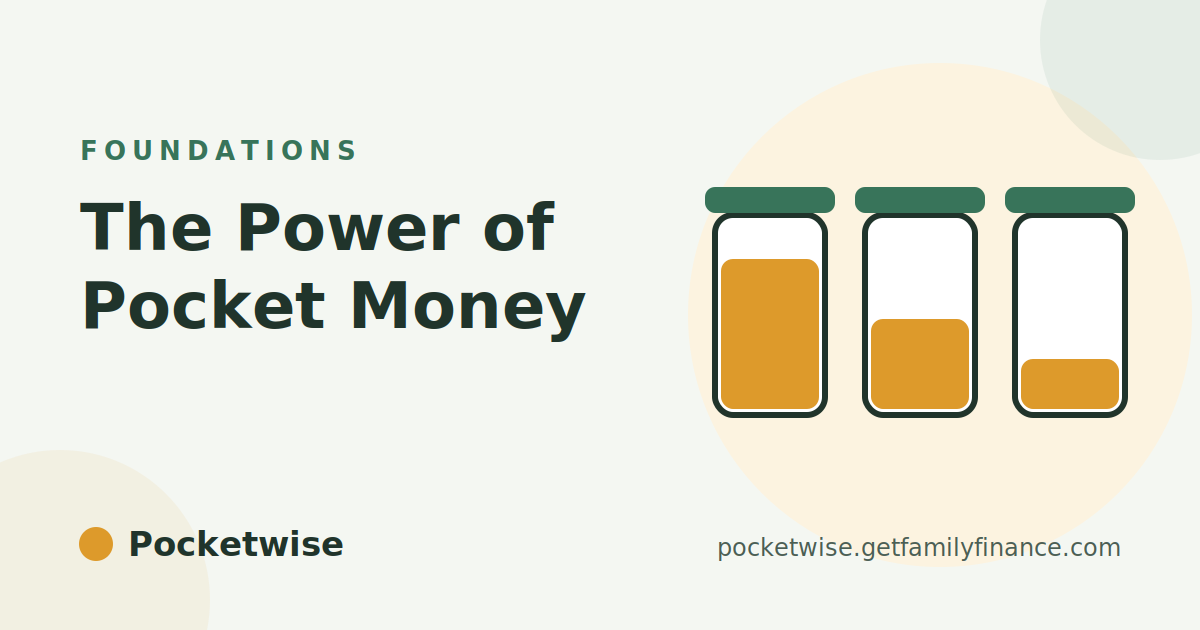
Where should the money go? The three-jar split
Handing over money is not the lesson. What happens next is:
| Jar | Share | Purpose |
|---|---|---|
| Spend | 50% | Free money. Their choice, including bad choices. |
| Save | 40% | A named goal they chose — game, bike, phone. |
| Share | 10% | Giving — a charity they pick, a gift they fund. |
Three rules make it work:
- The save jar needs a named goal with a picture. "Saving" is abstract; "the $180 skateboard, $72 in" is a progress bar.
- Never raid the jars, and never bail out an empty spend jar. The system runs on consequences being real.
- Let the bad purchase happen. When three weeks of spend money buys a toy that breaks in a day, skip the rescue and the lecture. One sentence — "annoying, hey? What would you do differently?" — and let the experience teach.
A $12 mistake at ten prevents a $1,200 version at twenty.
Jars, cash, or card?
The right tool depends on age:
Ages 6–9: clear jars and cash. Young kids need to see money. Three jars on a shelf beat any app, because the save jar visibly fills.
Ages 10–12: the digital transition. This is when tap-and-go and in-game purchases arrive — money kids can spend but not see. Move the system onto a kids' debit card with one feature above all: the child watches their own balance fall the moment they tap. The feedback loop you built with jars survives the jump to digital.
Ages 13–15: more money, more responsibility. Bigger allowance, bigger obligations — their own social spending, their own subscriptions, part-time earnings landing in the same account. The parent app shifts from control to coaching: "the save balance stopped growing — what changed?"
US specifics: amounts, taxes, and tools
Typical amounts: US surveys put average allowance around $10–15/week for tweens and $20–30/week for teens with broader responsibilities. The $1-per-year-of-age rule lands comfortably inside those ranges.
A teen-earnings note: once your teen starts real part-time work, their first $15,750 of earned income (the 2025 federal standard deduction for a single filer; the figure adjusts annually) is effectively federal-income-tax-free, though payroll taxes still apply — a fact that makes a great "look how the system actually works" conversation.
Going digital: the dominant US tool for the ages-10+ transition is Greenlight — a kids' debit card with a parent app that automates weekly allowance, splits money into spend/save/give buckets (the three-jar system, digitized), pays parent-funded interest on savings, and lets you attach pay rates to bonus chores. It runs $5.99–$14.98/month per family depending on plan, so weigh the fee against the automation; for many families, "allowance pays itself on time, every time" alone justifies it.
Free alternative: the CFPB's Money as You Grow guides (consumerfinance.gov) pair well with a plain cash-and-jars setup if you'd rather not pay a subscription yet.
The 15-minute setup
- Pick the amount — start at $1 per year of age.
- Agree the split — 50/40/10 is a fine default. Write it down together.
- Name the savings goal — their choice, with a picture stuck where the money lives.
- Price three or four bonus jobs in advance.
- Automate payday — same day every week, no exceptions.
- Book a monthly five-minute money chat — what did you buy, how's the goal, any regrets?
Then get out of the way. The system teaches; your job is keeping it running and the consequences real.
What does success look like?
Not a child who never wastes money — a child who wastes a little, notices, and adjusts. Within six months, most parents report the same three milestones: the first unprompted "not worth it," the first saved-up goal achieved, and the first time their kid prices something in weeks-of-allowance without being told.
That last one is the big one. Money has stopped being magic and started being maths.
Frequently asked questions
How much pocket money should I give my child?
A practical starting rule is $1 per year of age per week — $10/week for a ten-year-old — adjusted for what the money must cover and what your budget can sustain every single week. Consistency matters more than the amount.
Should allowance be tied to chores?
The hybrid approach works best for most families: a small unconditional base allowance (learning money), expected family chores that aren't paid, and optional bonus jobs that earn extra at agreed rates. This teaches both family contribution and that work converts to income.
What is the three-jar pocket money system?
Split every allowance payment into Spend (about 50%), Save (about 40%, toward a goal the child names), and Share (about 10%, for giving). The split — and watching the save jar grow toward a pictured goal — is what turns allowance into financial education.
When should kids switch from cash to a debit card?
Around ages 10–12, when they start encountering tap-and-go and online spending. Choose a kids' card whose app shows the child their own live balance and savings goals, so the visibility that physical jars provided survives the move to digital money.
Should I bail my child out if they spend all their pocket money?
No — the system only teaches if consequences are real. An empty spend jar at age ten is the cheapest money lesson they will ever get. Acknowledge the frustration, ask what they'd do differently, and let payday arrive on schedule.